Showing posts with label ICU. Show all posts

Saturday, December 10, 2016

The Journey of a 1000 Miles (APIWATWOL #4)

#4 in the "A Picture is Worth a Thousand Words or Less" series. (For a description of how this series works, see installment #1)
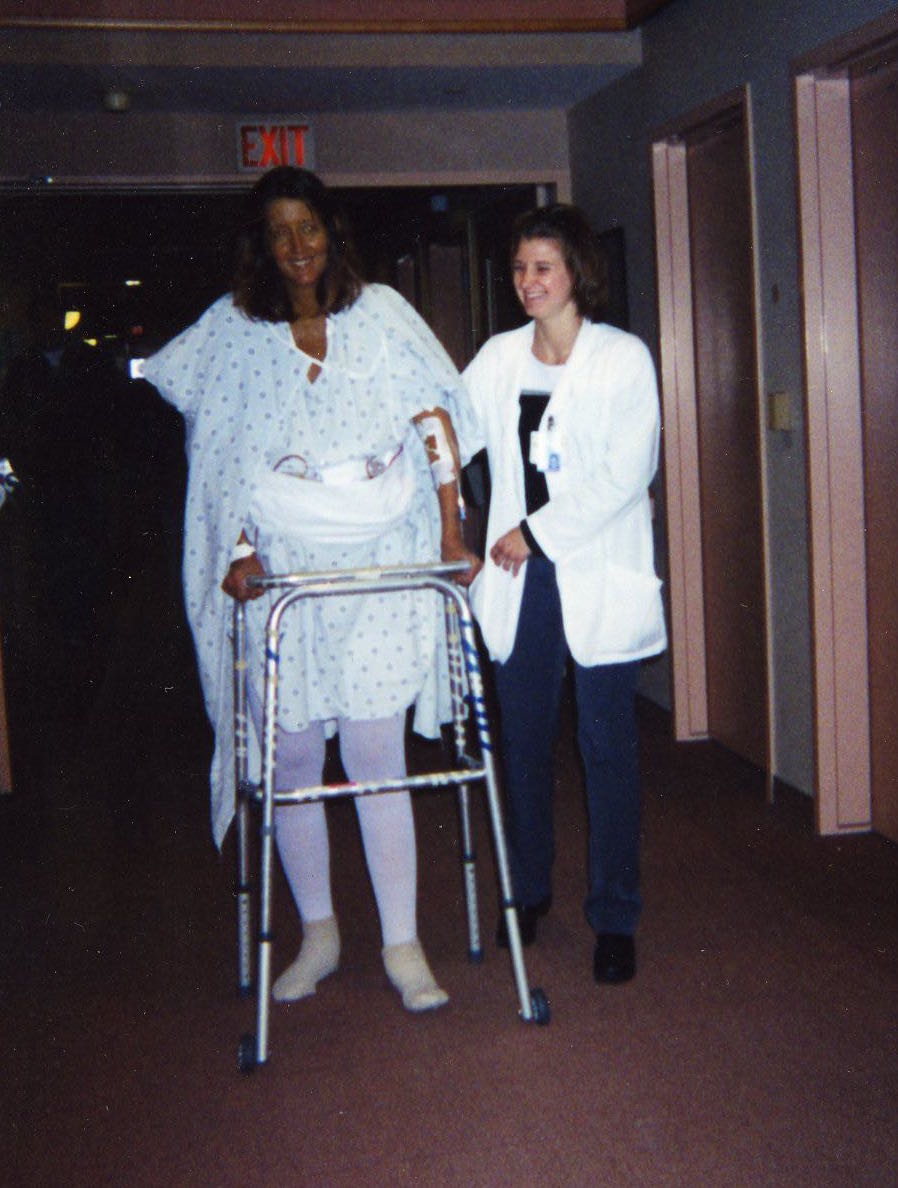


The photo I chose at random for this installment of my new blog series, A Picture is Worth a Thousand Words or Less, was taken by Jeff in April of 2000, while my newborn baby girl was living 400 miles away with my brother’s family and I was on my sixth week in the hospital after a fairly significant childbirth-gone-bad experience.

That odd thing wrapped around my waist—the one that looks, ironically, like a baby sling—is holding four plastic containers attached to tubes inserted into my midsection for the purpose of collecting drainage from my third surgery that month. An extra hospital gown is tied around my neck like my very own Superwoman cape (and trust me, I did feel like Superwoman in that moment)—my nurse's attempt at preserving my dignity. As if I had any left at that point. 

You'll see that I am smiling—a Pavlovian response to the word cheese offered by Jeff as he snapped the photo. In actuality, I recall feeling mildly annoyed by the simple request of a photo, not out of vanity but because I felt I was going to puke any moment, the vertigo created by lying inert for five weeks rather overwhelming. I had set my goal at making it to the nurse's station about twelve meters from my hospital room, and pausing for even five seconds and raising my eyes the slightest bit to meet the camera lens felt like both a monumental burden and needless imposition. 

Beside me is Amy, my physical therapist, more upbeat than usual because it was the first time she’d managed to get me beyond the confines of my room. When I first met Amy, she asked me to lift my right leg off the mattress. No matter how much I willed my leg to rise, it lay there like a recalcitrant cinderblock. Same with the left leg. 

The next time Amy came to visit, I feigned sleep. She left without a word.

By my third Oscar-worthy slumber performance, Amy was on to me. I could no longer put her off. And so the real work of my recovery began, the work that involved greater reserves of tenacity than I had heretofore known existed within me. At that point in my life, I had completed six marathons. Not one had come close to the challenge afforded by learning to walk again.

My physical therapy sessions were grueling, both physically and mentally. Many days, I would’ve preferred to curl up in a ball and slip away to The Great Unknown, the way animals that know they're mortally wounded do. But our human ability to think is, as they say, what sets us apart. And my mind was full of thoughts of a baby I had yet to meet but for one brief visit when my brother and sister-in-law flew in for the day with Clare. Many times I thought my little girl was better off with them, hell, with anyone but me.

But every so often, such as the afternoon this photo was taken, I managed to muster up the old Lauren, the Lauren whose grit and stubborn optimism could overcome any challenge Life threw in her path. Like the task of making it all the way to the nurse’s station before pivoting and returning to the comfort of my bed and another dose of morphine. These were the moments that, I believe, helped me beat the medical odds of my illness. That allowed me to run one more marathon a year-and-a-half later just to prove to myself that I could.


Thursday, July 11, 2013

If She Dies...


The story goes like this: After receiving the “you’d better come now” phone call from our mother, my sister Karen arrived in San Francisco on the 5th of 38 days I would spend in the intensive care unit. I was nearing the triple-digit mark in pints of blood transfused, and apparently – though I can’t confirm this because I was comatose at the time – I looked like hell.

My brother, ever the family patriarch since our father’s untimely death when we were kids, felt the need to warn Karen before taking her into my hospital room. “Heads up,” Tim said to her in the ICU hallway. “Lauren is twice her usual size and looks as if she’s been floating facedown in a river for weeks. It’s not a pretty sight.”

They entered my room and took their places on either side of the high-tech bed, where Karen – both my best friend and nemesis growing up – got her first glimpse of me: bloated, unconscious, amber-yellow skin, lips curled back from my teeth, and tubes, wires, and machinery crowding and connecting to my barely functioning body. Despite years of working with the sick and dying in hospitals and nursing homes, Karen’s expression betrayed her shock that the ghastly and unresponsive body in the bed was indeed her little sister. It was at this point that my brother leaned across my distended abdomen (thank you, liver failure) toward my sister and said, “If she dies, I get her bike.”

It’s an age-old family joke that elicits a scowl from our mother every time my siblings and I say it to one another, usually when one of us is embarking on a lengthy journey or precarious endeavor. “I love you” has never come easily for my family, and humor – served with a healthy dose of “noogies” – was our preferred expression of affection growing up. Tim’s utterance of those seven words, at a time most would deem highly inappropriate, brought an immediate smile to Karen’s face while simultaneously incensing the attending nurse, who hadn’t yet come to know, or appreciate, my family’s sick sense of humor.

The off-color jokes continued over the coming weeks, most frequently during the worst of times. While sitting in the ICU waiting room after receiving particularly disconcerting news about my prognosis, my family and a few close friends had a group meltdown. Not one of them was able to muster any of the optimism they had taken turns providing when one or another of them would lose faith in my ability to recover. Then, without warning, my sister started laughing. “She can’t die,” she said with such certainty the others stopped crying long enough to hear her reasoning. “Why not?” someone asked. “Because,” Karen said, as if stating the obvious, “that would deprive us of the pleasure of killing her for putting us through this nightmare!” And with that, the tension broke and tears were transformed to laughter, offering the briefest of reprieves – but a reprieve nonetheless. 

Inappropriate? You bet. Lacking tact? Yup. Necessary for my family as they dealt with the devastating probability that I wouldn’t pull through? Absolutely!

Not only do I enjoy hearing the dark humor anecdotes of my time spent in the ICU, but I applaud my siblings for having had the courage to “go there.” Sometimes, the only way to face the horrific is with irreverence and absurdity. In the toughest of times, I find that humor is like chocolate: the darker it is, the better it is for you.

"No, you can't have my bike."
And I'm happy to report that my bike remains unequivocally in my possession.


* * * * * * * * * * * * * * * * * * * * * * * * * * * * * * * * * * * * * * * * * * * * * * * * * * * * * * * * 
Download a PDF of the first 4 chapters of Lauren's memoir, Zuzu's Petals: A True Story of Second Chances, free.  Click here and go to the link below the "Buy the Book" button.  Zuzu's Petals is also available on Kindle and Nook.  Hardcover signed and inscribed copies are available at  www.laurenwardlarsen.com. Happy reading!


Thursday, December 8, 2011

One Smart Nurse


I was told there were flowers—lots and lots of flowers.  And the occasional balloon bouquet.  I was told they arrived almost daily and, one by one, they were sent down to the children’s area of the hospital.  My ICU room was small and every bit of space was needed for machines and IV poles and the lone reclining chair in which one family member or close friend would spend the night.  Besides, I wasn’t exactly what you’d call “responsive” during those weeks. It wasn’t like I could actually appreciate the flowers and balloons.


And then, I was told, the flowers stopped arriving.  And in their place came notes—notes that said things like “I gave blood in honor of Lauren today” and “We set up a blood drive to help Lauren.”

Why the change?

A nurse. One very smart ICU nurse who knew that I was draining the local blood supply with my nonstop internal hemorrhaging.  She saw the needs of the various people involved: my family’s need to “do” something; neighbors’, friends’ and work colleagues’ need to show they cared; the local blood center’s need to replenish the red blood cells, platelets, and plasma that I was using at a disproportionate rate; and, of course, my need for more blood. And then that one smart nurse offered my family a suggestion that would meet all of our needs.

“You might want to ask Lauren’s friends who are sending flowers to give blood instead,” she said.  My family responded with enthusiasm.  The only bit of information they wanted in order to get started was how our friends could direct the blood they donated to me.

“Well, that’s just it,” the nurse said. “They can’t. These donations would be in honor of Lauren, but not necessarily for Lauren. But that doesn’t mean it’s not helping.  It’s replacing the blood that she’s been using.  And some of it might make its way to her, but there are no guarantees.” 

Life in the ICU
That was good enough for my family. They began putting the word out in full force, not just locally but to friends and extended family members across the U.S.  My mom manned our home phone and asked everyone who called to give an hour of their time and a pint of their blood. My siblings sent mass e-mails, which were then forwarded on from there. One neighbor organized a blood drive at her school while another organized a neighborhood drive. One of my brother’s clients hosted a drive and had everyone who donated sign a get-well poster for me. My former employer launched their inaugural blood drive, which has become an annual event still in place today.

By giving the loved ones of an ICU patient a focus—something proactive they could do when there was little else to do but wait—one nurse set in motion a ripple effect that would save countless lives with the blood that was donated as a result. Imagine the impact if we could mobilize nurses worldwide to offer this one simple suggestion to their patients’ families.

I wish I knew which of my dozens of nurses it was who made that one simple suggestion during my illness twelve years ago.  I would thank her for knowing how important it was to replenish the blood supply, as well as for understanding how badly my family needed her directive for their own survival of the ICU.

Whoever you are: damn you’re good!  And, oh yeah, thank you.


* * * * * * * * * * * * * * * * * * * * * * * * * * * * * * * * * * * * * * * * * * * * * * * * * * * 
Lauren's book, Zuzu's Petals: A True Story of Second Chances (In The Telling Press, 2011), is the #1 Top Rated memoir on Kindle. Hardcover copies are available at www.amazon.com, or signed copies can be ordered at www.laurenwardlarsen.com. Happy Reading!


Thursday, April 28, 2011

To Russia With Love


Peter was a Communist.  They all were: everyone who walked into my hospital room during my “crazy phase”—that ten-day period in the ICU during which encephalopathy caused me to scream about brains marching up my bed, yell for someone to help all the babies that were trapped in bags all over the floor, and accuse anyone wearing a white lab coat of being a Communist spy with designs of performing experiments on me (they were obviously—according to my warped view of reality—trying to “steal my sperm and eggs for evil purposes”).

But Peter?  He even had the accent.  And every time he spoke with my family members (who for whatever reason I actually remembered were family members), they always laughed.  He was a comedic Communist, that Peter.

Weeks after the encephalopathy dissipated and I moved to a step-down unit, Peter still stopped by my room during his coffee breaks.  He would spend a few minutes with me, or chat with my mother and share a laugh with her.  In time, I came to realize that those visits were as important to Peter as they were to my family and me.  How often had Peter come to bond with a patient in the ICU only to see his or her body sent to the morgue after days, weeks of heroic effort to save them?  Visiting me was, perhaps, Peter’s way of reminding himself that happy endings were possible in the ICU.

Months after my discharge from the hospital, I sent Peter a gift and thanked him for all he’d done, not just for my well-being, but for my family’s.  His ability to help them find humor during the darkest days of my illness was a skill not likely taught in his nursing program.  But Peter instinctively understood and nurtured the need for laughter, for finding whatever joy was possible for the loved ones of the critically ill. 

It would be years before I’d reconnect with Peter online.  He had since moved to Russia—ironically—to work as a nurse practitioner for the Foreign Service.  After the usual “how’ve you been” and “thank you again for all you did for me” that accompanies reuniting with those who helped save your life, we launched a nice friendship.  Seeing that I was open to the Mystery (capital M intended) of life, Peter shared with me a dream he’d had while I was ill and not expected to live.  In it, he saw me laughing with my husband, and that confused him.  “Lauren!” he said to me in the dream, “this can’t be! I mean, you died!”  I laughed at him and replied, “Oh Peter, that was such a long time ago!” That dream—he told me—had provided him with the hope he needed to go back into work for another 18-hour shift and give me his all. And eventually, his all worked.

Peter also told me that he’d wanted so badly to donate blood for me while I was ill, but that his having thalassemia prevented him from doing so.  But that doesn’t stop him from helping other blood recipients today. Historically, the blood services in Moscow only accepted blood donations from Russians, but Peter was able to persuade them otherwise.  64 donors—only 12 of whom were Russian—turned out for the first-ever blood drive at Peter’s workplace.  The local media was all over the story, and the Embassy Moscow Blood Drive is now an annual event.

Peter was one of more than 80 nurses who worked hard to save my life in the ICU.  And while burnout led him to seek a calmer arena within healthcare, today he continues to save lives—more than he even knows. Most of the people who’ve been touched by Peter’s blood drive efforts won’t ever know that he was the driving force behind the life-saving blood they received.  They won’t track him down to say “thanks for saving my life.” But I know.  So here’s to Peter in Russia. With love. 


Download a PDF of the first 4 chapters of Lauren's memoir, Zuzu's Petals: A True Story of Second Chances, FREE here.  Click on the link below the green "Buy the Book" button.  Happy reading!